
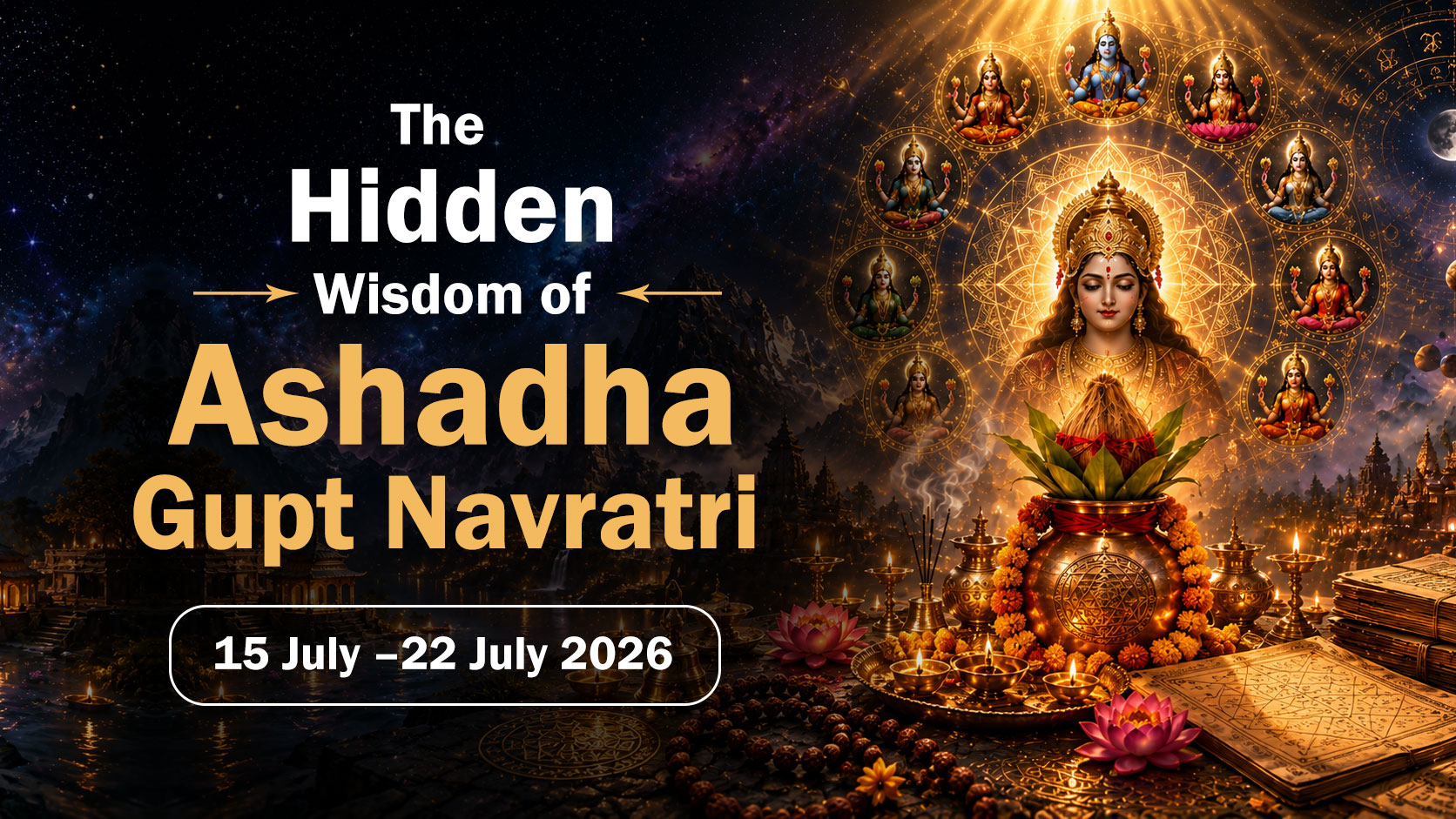
The Hidden Wisdom of Ashadha Gupt Navratri
Some sacred days are meant to be celebrated. Others are meant to be experienced in silence. Ashadha Gupt Navratri belongs to the latter.
Most festivals in Sanatan Dharma are filled with celebration, music, and community gatherings. Ashadha Gupt Navratri is different.
Observed from 15 July to 22 July 2026 (with Parana on 23 July), these sacred days gently invite us to slow down, turn inward, and reconnect with the Divine.
Dedicated to Divine Shakti, Ashadha Gupt Navratri is traditionally associated with the worship of the Dash Mahavidyas—the Ten Great Wisdom Goddesses.
Unlike Chaitra and Sharad Navratri, Gupt Navratri is not about public celebration. It is about quiet Bhakti, sincere Sadhana, and preparing the heart for a deeper spiritual journey.
Why Is Ashadha Gupt Navratri So Significant?
Life today rarely slows down. Our minds are constantly occupied with work, responsibilities, notifications, expectations, and endless thoughts. In the middle of this noise, we often lose our connection with ourselves.
Perhaps this is why our Rishis gave us Ashadha Gupt Navratri.
Observed at the beginning of the monsoon, when nature itself begins to slow down and renew, these sacred days remind us to do the same. Just as the rains cleanse the earth, Gupt Navratri invites us to cleanse the mind of fear, anger, attachment, and restlessness.
It is not merely a time for worship. It is an opportunity to become Antarmukhi (turn inward), rediscover inner peace, and prepare the heart for a deeper spiritual journey.
A Sacred Journey Begins
Soon after Ashadha Gupt Navratri begins Chaturmas—the four holy months traditionally dedicated to Sadhana, scriptural study, self-discipline, and a simpler way of living.
These nine sacred days prepare the seeker to begin that journey.
After Ashadha comes the sacred month of Shravan, bringing us closer to Shiv Ji—Mahadev, who teaches us the path of silence, simplicity, compassion, and complete surrender.
If Ashadha Gupt Navratri awakens Shakti within us, Shravan inspires us to offer that awakened Shakti at the lotus feet of Mahadev through Bhakti, Dhyaan, and Sadhana.
In the philosophy of Sanatan Dharma, Shiv Ji and Shakti are inseparable. Shiv Ji represents the eternal, unchanging truth, while Shakti is the divine force through which creation, preservation, and transformation take place. One is complete only with the other, reminding us that strength and surrender, action and stillness, must always exist in harmony.
The Hidden Wisdom of the Dash Mahavidyas
Ashadha Gupt Navratri is traditionally associated with the worship of the Dash Mahavidyas.
The Dash Mahavidyas reveal ten divine paths through which a seeker gradually rises above fear, attachment, anger, ignorance, and ego. Their worship is not merely an act of devotion to the Divine Mother. It is a sacred journey towards Chitta Shuddhi (purification of the heart and mind), allowing the Atma to shine without the veils of Ahankaar (ego), Moh (attachment), and Avidya (ignorance).
The Mahavidyas teach us that the greatest battle is rarely with the world around us. It is with our own thoughts, fears, desires, and ignorance.
As these are gradually purified through sincere Sadhana, the Divine qualities already present within every soul begin to reveal themselves naturally.
Perhaps this is the hidden wisdom of Gupt Navratri. The journey is not about gaining power over the world, but about discovering mastery over oneself.
How Can You Observe Ashadha Gupt Navratri?
The essence of Gupt Navratri is not the complexity of rituals but the sincerity of your Bhakti and Sadhana.
Even if you can dedicate just 15 to 20 minutes each day, these sacred days can become deeply meaningful.
If time permits, you may read a portion of the Durga Saptashati, one of the most revered scriptures dedicated to Maa Durga. If reading the entire text is not possible, even reading a few verses with faith and devotion is meaningful.
Our Rishis also gave us Mantras as a means to steady the mind and invoke Divine Grace. A mantra is not merely a collection of words—it is a sacred vibration that gently turns the mind away from worldly distractions and towards the Divine.
You may chant any one of these according to your devotion.
बीज मंत्र
ॐ ऐं ह्रीं क्लीं चामुण्डायै विच्चे॥
प्रार्थना मंत्र
सर्व मंगल मांगल्ये शिवे सर्वार्थ साधिके।
शरण्ये त्र्यम्बके गौरी नारायणि नमोऽस्तुते॥
देवी स्तुति
या देवी सर्वभूतेषु शक्तिरूपेण संस्थिता।
नमस्तस्यै नमस्तस्यै नमस्तस्यै नमो नमः॥
If mantra chanting is new to you, simply sit quietly before Maa Durga, close your eyes, and offer your prayers with gratitude. Even a few moments of sincere Smaran (remembrance) and Bhakti (devotion) are a beautiful form of Sadhana.
Remember, the Divine looks not at the length of our worship, but at the purity of our heart.
A Final Reflection
Our Rishis did not give us these sacred days merely to perform rituals. They gave them so that we may pause, become Antarmukhi (turn inward), purify our Antahkarana (our inner being), and deepen our Bhakti.
Perhaps that is the true blessing of Ashadha Gupt Navratri—not simply seeking the Divine, but becoming more aware of the Divine presence that already resides within us.
May these sacred days inspire peace in your mind, purity in your heart, and strength on your spiritual journey.